How Many Reps Should You Do for Muscle Growth?
One of the most common questions people ask at the gym is: How many repetitions should I perform to build muscle?
Some people believe that 8–12 reps are best for muscle growth, while others prefer lifting heavier weights for fewer repetitions. But is there really one perfect repetition range for building bigger and stronger muscles?
The truth is that muscle growth can happen across a wide range of repetitions, provided your training is challenging enough, your technique is correct, and your workout programme is properly structured.
Let’s understand how repetitions work and how to choose the right number of reps for your fitness goals.
What Are Repetitions in Strength Training?
A repetition, commonly called a rep, is one complete movement of an exercise.
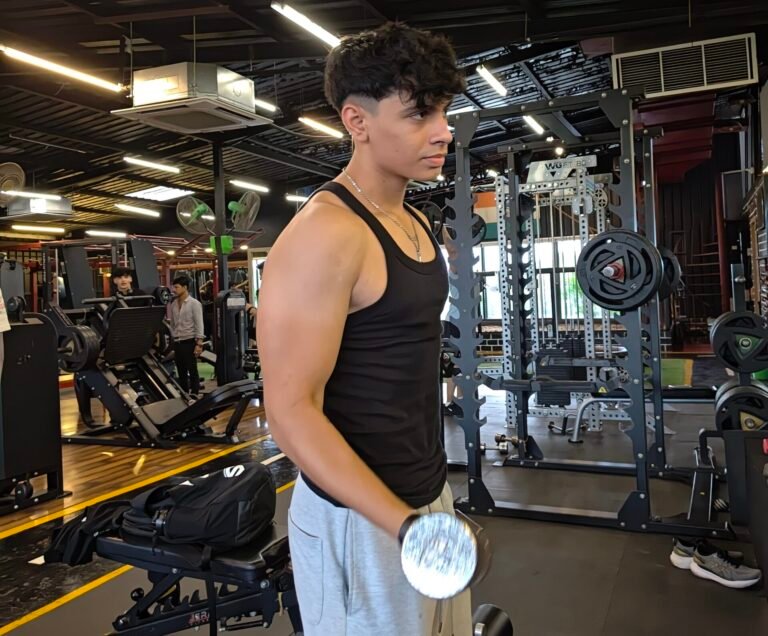
For example, performing one complete bicep curl from the starting position and returning to the starting position counts as one repetition.
A set is a group of repetitions performed continuously before taking a rest.
For example:
- 10 bicep curls = 10 repetitions
- 3 rounds of 10 curls = 3 sets of 10 reps
The number of repetitions you perform influences the weight you can lift, the difficulty of your workout, and the overall training stimulus.
How Many Reps Are Best for Muscle Growth?
For many people, a range of approximately 6–15 repetitions per set is a practical starting point for muscle-building workouts.
However, muscle growth is possible across a broader range, including lighter loads with higher repetitions and heavier loads with lower repetitions.
What matters is that the working sets provide sufficient effort and that you progressively challenge your muscles over time.
Here is a simple breakdown:
1. Low Reps: 1–5 Repetitions
Low-repetition training generally involves heavier weights.
Main focus:
- Developing maximum strength
- Improving the ability to lift heavy loads
- Practising heavy compound movements
Examples:
- Heavy Squats
- Deadlifts
- Bench Press
This approach is useful for strength development. However, very heavy training requires good technique, experience, and appropriate safety measures.
2. Moderate Reps: 6–12 Repetitions
This is a popular repetition range for muscle-building programmes.
Main focus:
- Building muscle
- Developing strength
- Managing training volume
- Using challenging but controlled resistance
Examples:
- Dumbbell Bench Press
- Barbell Rows
- Shoulder Press
- Leg Press
For many gym-goers, this range provides a practical balance between resistance and repetitions.
3. High Reps: 13–20+ Repetitions
High-repetition training generally uses lighter weights.
Main focus:
- Building muscular endurance
- Increasing training volume
- Providing additional muscle stimulus
- Training with controlled movements
Examples:
- Lateral Raises
- Cable Flyes
- Leg Extensions
- Bicep Curls
High-repetition sets can also stimulate muscle growth when performed with sufficient effort.
Does Lifting Heavy Weights Build More Muscle?
Not necessarily.
Research indicates that muscle growth can occur with both lighter and heavier weights when sets are performed with sufficiently high effort.
However, heavier weights are generally more specific to improving maximum strength.
For muscle growth, you do not need to lift the heaviest weight possible in every workout.
Instead, choose a weight that allows you to perform your target repetitions with good technique while making the final repetitions challenging.
Understanding Reps in Reserve (RIR)
One important concept in muscle-building training is Reps in Reserve, commonly called RIR.
RIR refers to how many additional repetitions you believe you could complete before reaching muscular failure.
For example:
- 0 RIR: You cannot complete another repetition with proper form.
- 1 RIR: You could perform approximately one more repetition.
- 2 RIR: You could perform approximately two more repetitions.
- 3 RIR: You could perform approximately three more repetitions.
For many working sets, finishing with around 1–3 reps in reserve is a useful approach.
You do not need to reach complete muscular failure in every set. Maintaining good technique and managing fatigue are important.
How Many Sets Should You Do for Muscle Growth?
Repetitions are only one part of muscle-building training. The number of sets you perform also matters.
A practical starting point for many adults is approximately 10–20 challenging sets per muscle group per week, adjusted according to experience, exercise selection, and recovery.
Beginners may make progress with less volume, while experienced lifters may need more carefully managed training volume.
For example, a weekly chest routine could include:
| Exercise | Sets | Reps |
|---|---|---|
| Bench Press | 3 | 6–10 |
| Incline Dumbbell Press | 3 | 8–12 |
| Cable Fly | 2–3 | 12–15 |
This is an example, not a fixed prescription. Your total weekly chest volume should account for all pressing and chest exercises across your training sessions.
Recommended Rep Ranges for Different Muscle Groups
There is no mandatory repetition range for each muscle group. However, the following ranges can be useful starting points.
| Muscle Group | Exercise | Suggested Reps |
|---|---|---|
| Chest | Bench Press | 6–10 |
| Back | Lat Pulldown | 8–12 |
| Shoulders | Lateral Raises | 12–20 |
| Biceps | Dumbbell Curls | 8–15 |
| Triceps | Cable Pushdowns | 10–15 |
| Quadriceps | Squats | 6–12 |
| Hamstrings | Leg Curls | 10–15 |
| Calves | Calf Raises | 10–20 |
Choose repetitions that allow you to maintain proper form and control throughout the movement.
Sample Muscle-Building Workout
Here is an example of a push workout combining different repetition ranges.
| Exercise | Sets | Reps |
|---|---|---|
| Barbell Bench Press | 3 | 6–10 |
| Incline Dumbbell Press | 3 | 8–12 |
| Shoulder Press | 3 | 8–12 |
| Lateral Raises | 3 | 12–20 |
| Triceps Pushdowns | 3 | 10–15 |
The goal is to train each muscle effectively without sacrificing exercise technique.
How to Choose the Right Weight for Your Reps
Selecting the correct weight is just as important as choosing the number of repetitions.
Follow these steps:
Step 1: Select your target repetition range.
For example, choose 8–12 reps for dumbbell bench press.
Step 2: Start with a manageable weight.
Choose resistance that allows you to complete the repetitions with proper technique.
Step 3: Evaluate your effort.
Your final repetitions should feel challenging, but you should still maintain control.
Step 4: Track your performance.
Record the weight, sets, and repetitions after each workout.
Step 5: Apply progressive overload.
When you can consistently complete the upper end of your target repetition range with good form, consider increasing the weight slightly.
For example:
- Session 1: 10 kg × 8 reps
- Session 2: 10 kg × 10 reps
- Session 3: 10 kg × 12 reps
- Session 4: Increase weight slightly and work towards 8 reps again.
This approach helps you improve gradually.
Common Mistakes to Avoid
1. Believing That Only 8–12 Reps Build Muscle
Muscle growth is possible across a broad range of repetitions. The quality and effort of your training matter.
2. Using Excessive Weight
Lifting too heavy can affect your technique and reduce movement control.
3. Performing Every Set Until Failure
Training to failure can be useful in some situations, but doing it constantly may create unnecessary fatigue.
4. Ignoring Progressive Overload
Repeating the same weight and repetitions indefinitely may eventually limit your progress.
5. Neglecting Recovery and Nutrition
Muscle growth requires more than exercise. Proper protein intake, balanced nutrition, sleep, and recovery are essential.
What Matters More Than the Number of Reps?
If your goal is muscle growth, focus on these five factors:
- Training consistency: Follow a structured workout routine.
- Progressive overload: Gradually improve your training performance.
- Training volume: Perform an appropriate amount of challenging work.
- Proper nutrition: Consume sufficient protein and calories to support your goals.
- Recovery: Give your muscles enough time to recover between demanding sessions.
The perfect rep range cannot compensate for inconsistent training or inadequate recovery.
Final Thoughts: Find the Rep Range That Works for You
There is no single magic number of repetitions for muscle growth.
Moderate repetitions are a practical choice for many exercises, but lower and higher repetitions can also be effective when programmed appropriately.
Focus on selecting the right weight, maintaining proper technique, training with sufficient effort, and progressively improving your performance.
At Akhada – The Right Track Gym, Indore, you can work towards your muscle-building goals through structured strength training, functional workouts, and personal training guidance.
Start Building Muscle at Akhada – The Right Track Gym
Looking for the Best Gym in Indore to build muscle, improve strength, and achieve your fitness goals?
Visit Akhada – The Right Track Gym and get started with a workout routine suited to your fitness level.
Address: 3rd Floor, Press Complex, LIG Circle, AB Road, Near Dainik Bhaskar, Indore, Madhya Pradesh – 452011.
Contact: +91 9111100683
Frequently Asked Questions (FAQs)
1. How many reps are best for muscle growth?
Muscle growth can occur across a wide range of repetitions. Around 6–15 reps is a practical starting point for many exercises, but lighter and heavier loads can also work.
2. Are 8–12 reps better than 15–20 reps?
Not necessarily. Both ranges can support muscle growth when sets are sufficiently challenging. Your choice should depend on the exercise, training goals, and recovery.
3. Should I lift heavy or light weights to build muscle?
Both can build muscle. Heavier weights are particularly useful for strength development, while lighter weights can also stimulate muscle growth when performed with sufficient effort.
4. How many sets should I do per exercise?
Many people start with 2–4 working sets per exercise. The appropriate number depends on your weekly training volume, experience, and recovery.
5. Should I train every set to failure?
No. You can build muscle without reaching failure in every set. Finishing most working sets with around 1–3 repetitions in reserve is a useful strategy.
6. Can beginners build muscle with high repetitions?
Yes. Beginners can build muscle with higher repetitions, provided they use appropriate resistance, maintain proper form, and train with sufficient effort.
7. How long should I rest between sets?
For demanding compound exercises, around 2–3 minutes or longer may be appropriate. For smaller isolation exercises, approximately 1–2 minutes may be sufficient. Rest long enough to maintain performance and good technique.